THE PROJECT / SINCE 2010

A little ingenuity.
A much bigger sky.

PRuTHA is Kedar Soni’s passion project, begun in 2010. It brings together a long-running instrument experiment and a wish to make radio astronomy something students can do for themselves.

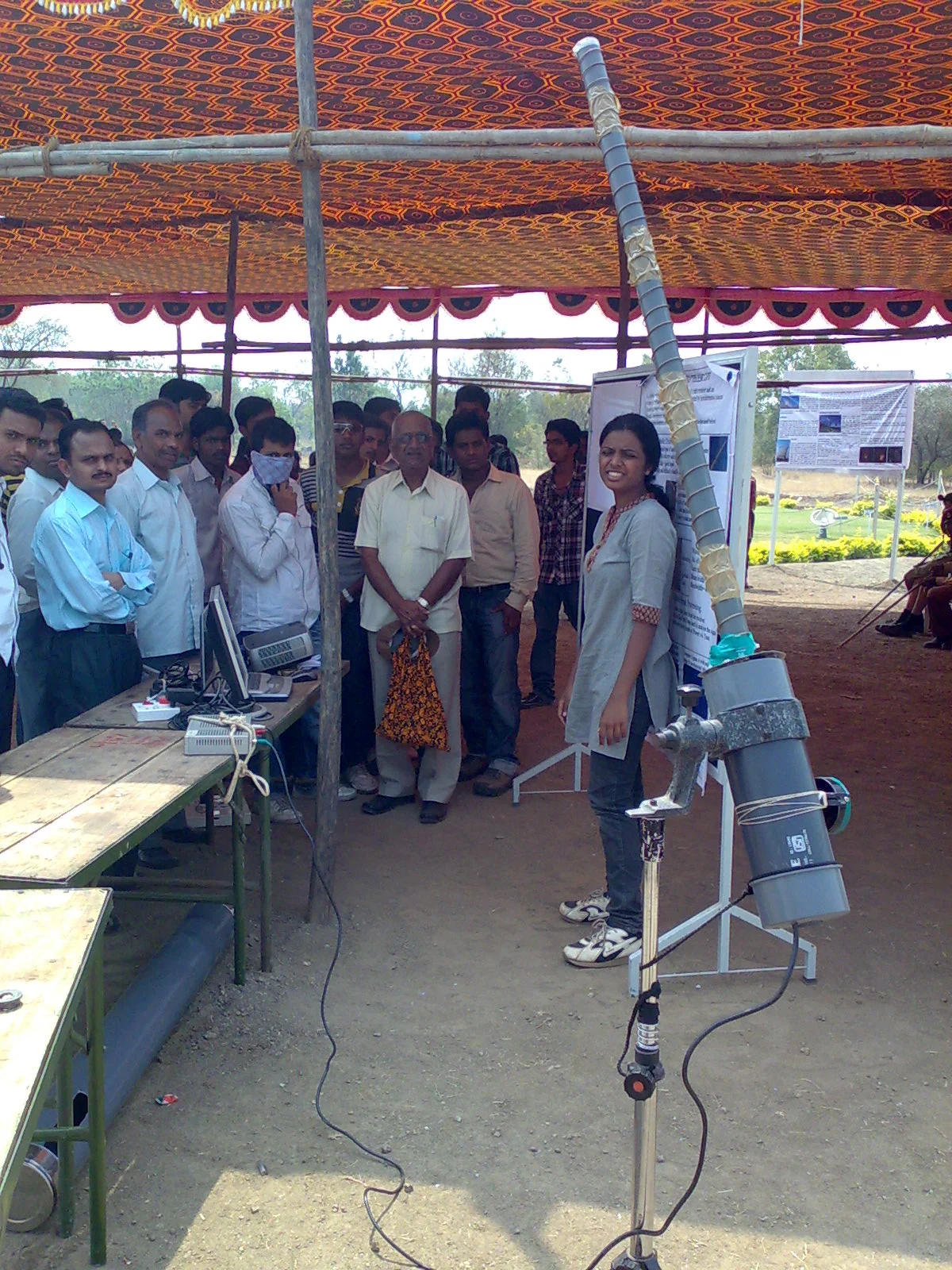
The early helix telescope being demonstrated at GMRT National Science Day
Early helix telescope demonstration · GMRT National Science Day, 2011

WHY WE KEEP BUILDING

Accessible equipment.
Serious curiosity.

Kedar Soni began the project in 2010 and has continued to lead its development. His starting question was simple: could ordinary components give school students a way into radio astronomy?

A helix antenna, a satellite set-top box and a laptop became the first working arrangement. Every subsequent version has brought new lessons about antennas, gain, calibration, interference and the limits of an observation.

Pooja helped develop the project’s ideas over roughly its first six years. Vaishnavi’s antenna construction and Iqra’s analysis have since made sustained contributions. Other students joined through shorter high-school internships.

WHAT WE ARE WORKING TOWARDS

Two connected ambitions.

THE INSTRUMENT

Small enough to carry.
Capable enough to investigate.

A radio telescope one person can carry, that a high-school student can assemble and operate, with help where needed. The target hardware budget is ₹10,000–15,000.

We want to explore sensitivity towards sources of order 1 Jy and the possibility of bright-pulsar observations. These remain goals to test, rather than established capabilities.

What does “1 Jy” mean?

A jansky (Jy) is a unit of spectral flux density: 1 Jy = 10−26 W m−2 Hz−1. Sensitivity depends on collecting area, receiver noise, usable bandwidth, integration time and interference. A target alone does not establish a detection.
THE CLASSROOM

Make hands-on radio
astronomy travel further.

Most teaching and mentoring so far has involved students from Kedar’s own school, Abhinav Vidyalay. The longer-term ambition is to take this practical approach to students in schools and colleges across India.

Students should be able to build, measure, spot a problem, change an explanation and defend a conclusion. A well-documented unsuccessful observation can teach as much as a convincing signal.

The telescope’s target budget is separate from workshop budgets. Existing computers, shared tools and teaching arrangements affect the final cost.

THE LONG EXPERIMENT

Progress, one
prototype at a time.

Selected milestones from the project records. Each iteration raises the next question.

  1. 2010

    A helix, a set-top box and a PC.

    The first 1.4 GHz helix arrangement is built and tested, using Radio-SkyPipe for recording.

  2. 2011

    Out of the lab, into conversation.

    The telescope is demonstrated at GMRT National Science Day. Student builds explore a horn and a dipole with a parabolic reflector. Automatic gain control becomes a key investigation.

  3. 2012–14

    More antennas. Better questions.

    Ku-band feed experiments, beam measurements and calibration work. The system is presented at the third Pro-Am meeting in Mumbai in October 2013.

  4. 2015–18

    Learning to trust the receiver.

    Student teams investigate SDR gain and beam response, then focus on astronomy and calibration.

  5. ONGOING

    SDRs, new builds and PRuTHABx.

    Helices and Yagis, RTL-SDR and HackRF receivers, and a software backend for recording and analysing observations.

  6. 2026

    From RALab to RadioAstroCourse.

    The laboratory idea develops into a proposed four-day programme built around a 610 MHz Yagi, solar observations and student reports.

TAKING THE WORK OUTSIDE

Demonstrations, talks & posters.

Presentations at GMRT National Science Day over several years, including award-winning work, have been part of sharing the project.

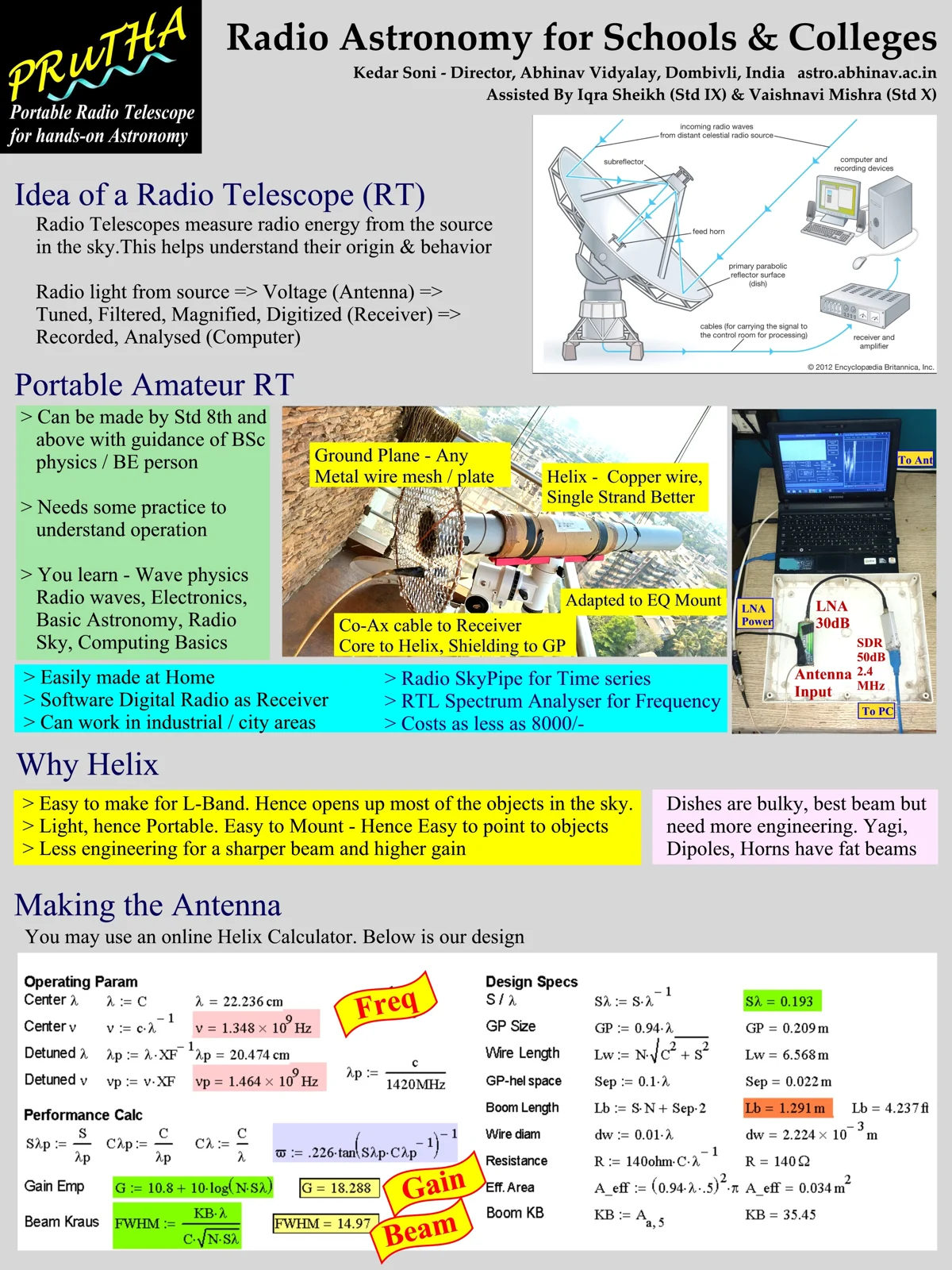
Radio astronomy for schools and colleges: design and conceptEnlarge image
Radio astronomy for schools and colleges · the concept
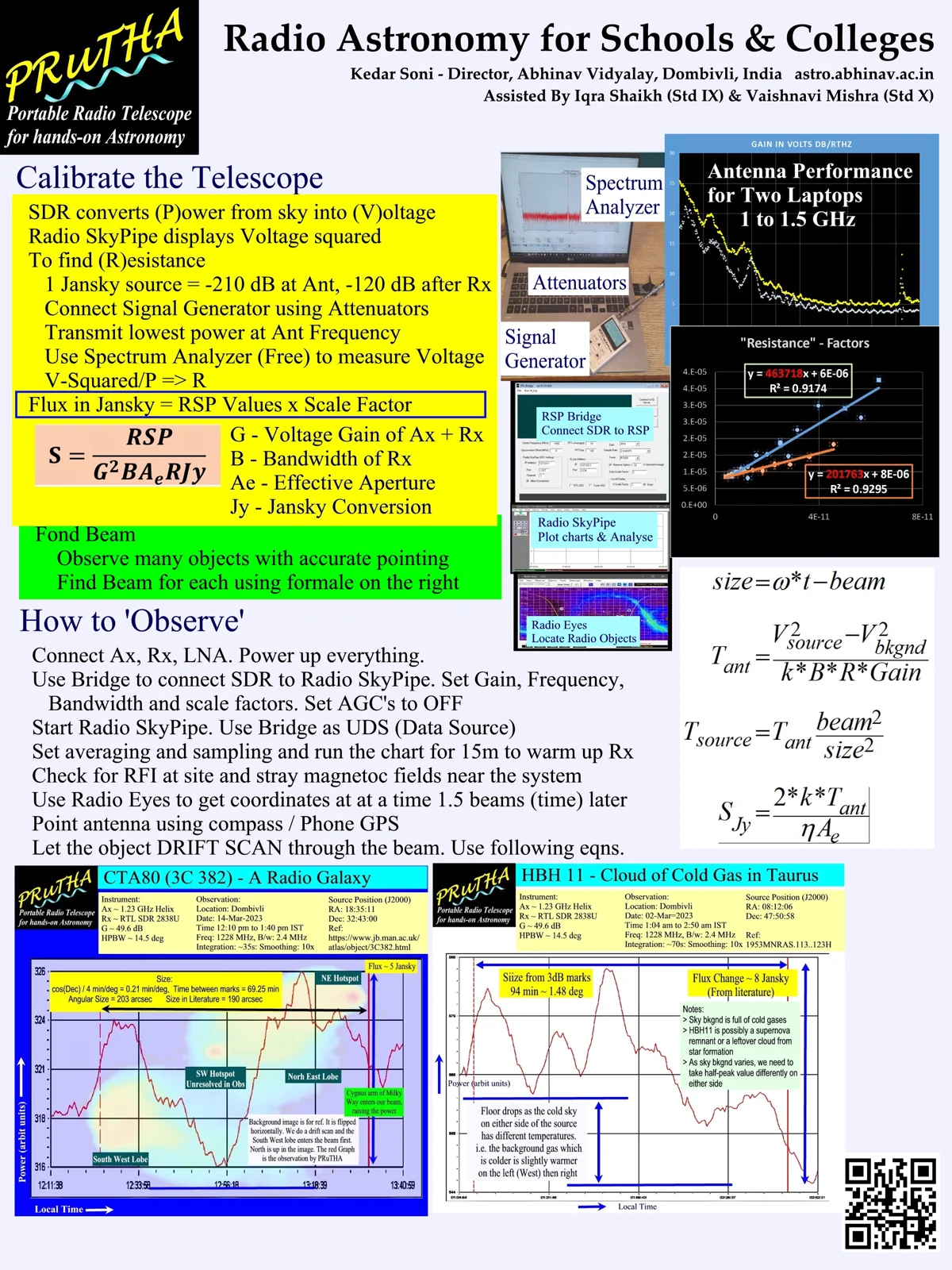
Radio astronomy for schools and colleges: the workingEnlarge image
Radio astronomy for schools and colleges · the working