Meet the invisible sky.
A talk and working demonstration introduce waves, radio sources, antennas and receivers. Teams practise plotting, units and power ratios.
Take away: a question, a plan and a team.
RADIOASTROCOURSE / THE CLASSROOM LAB
A proposed four-day introduction to radio astronomy, drawing on Kedar Soni’s work with students at Abhinav Vidyalay. The materials are designed for first-year undergraduates, with an accessible route for high-school learners.
Explore the teaching packFROM CLASSROOM IDEAS TO REAL EQUIPMENT
Students connect waves, electronics, measurement and astronomy in one experiment.
They measure and build an antenna, test connections, use a receiver, recognise interference, plot observations and decide what a graph actually supports.
The starting point is high-school physics and basic algebra. No prior astronomy or electronics experience is required. The depth of analysis can grow with the learners.
This workshop measures changes in received power as the Sun crosses an antenna beam. It does not produce a detailed image of the Sun.
THE COURSE ANTENNA
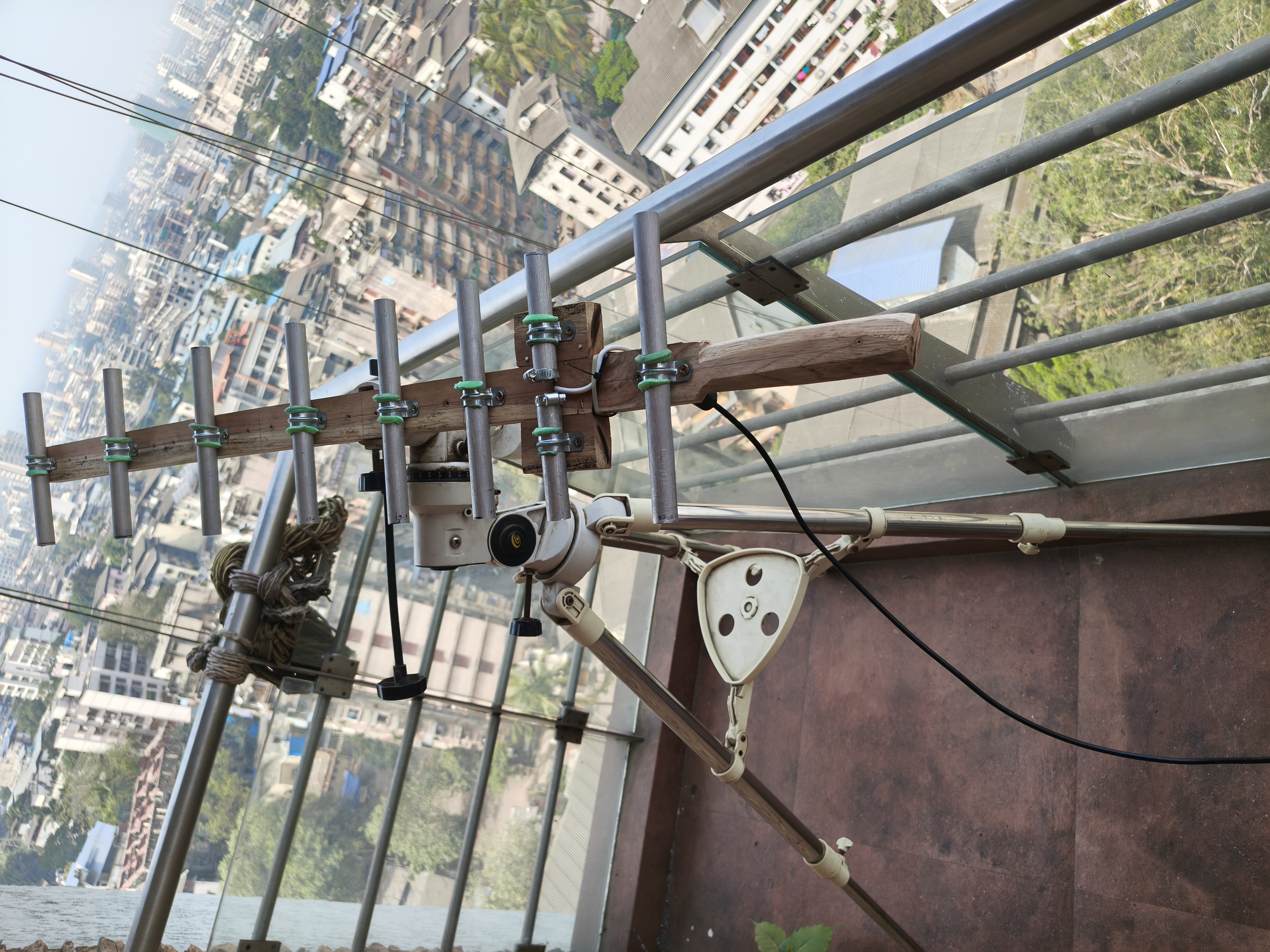
This 610 MHz Yagi brings the antenna work into view: the elements, their spacing along the boom, the feed connection and the mount all become things students can examine and discuss.
RadioAstroCourse connects this practical construction with receiver setup, solar drift scans and careful interpretation of the measurements.
Explore the construction materialsTHE PROPOSED FOUR-DAY PROGRAMME
A talk and working demonstration introduce waves, radio sources, antennas and receivers. Teams practise plotting, units and power ratios.
Take away: a question, a plan and a team.
Read the dimensioned drawing, build an eight-element Yagi, secure the feed and inspect continuity and isolation before connecting a receiver.
Take away: an antenna and a build record.
Set up shared receiver stations for solar drift scans. Log settings, background and interference. Preserve the original recordings.
Take away: a time-stamped observation.
Explore the beam, subtract background in linear power, estimate width where the data permit and present a report with limitations.
Take away: graphs, evidence and new questions.
FOR TEACHERS & DEPARTMENTS
The proposed format uses six team-built antennas, two shared SDR receivers and existing computers. It fits an introductory practical course, enrichment programme or supervised project.
Plan for a lead instructor, practical assistants, a coordinating teacher, safe construction benches and an outdoor area with a suitable view of the Sun’s path.
Two receivers support two continuous scans at once. Teams rotate through logging, interference checks and analysis; they do not each get a simultaneous full scan.
For a specific question about the teaching materials, contact details are available.
A roughly 35° beam gives about 140–153 minutes between solar half-power crossings. Allow around four uninterrupted hours, including baseline, and check the pointing plan beforehand.
The current proposal estimates ₹210–360 for each copper-wire antenna and ₹10,060–15,810 for an institution setup with six antennas, shared tools and two SDRs. These are indicative planning figures, not supplier quotations.
Allow separately for mounts, existing or new computers, additional cables, printing, protective equipment, transport and teaching time. Obtain current local quotations before purchase.
Download the full proposal and options (DOCX)Review the build, observation log, graphs and scientific report. Ask each student to explain a design choice and a result, including what remains uncertain.
TAKE IT TO THE WORKBENCH
Download the revised complete pack for all six student and instructor sheets. Prototype dimensions and equipment choices should be checked on the actual build.
Programme, institution options, budgets and the complete classroom pack.
Original introductory slides; use alongside the revised workshop pack.
Dimensions, assembly and checks.
Included in the complete packLog the setup and analyse the transit.
Included in the complete packAngular measurements and plotting.
Included in the complete packPreparation, answers and troubleshooting.
Included in the complete packStarting bill of materials and budget.
Included in the complete packSupporting calculations and student exercises.
Included in the complete packAll six sheets are included in the complete DOCX download above. Follow its print guide when making student and teacher copies.
Course by Kedar Soni · Assisted by Vaishnavi Mishra and Iqra Shaikh
THE RALAB IDEA
The earlier RALab proposal connected radio physics, astronomy and instrumentation. RadioAstroCourse gives that idea a concrete starting point. Beyond the first workshop, students can investigate beam patterns, gain stability, calibration and repeat observations as longer projects.